


A recent highlight for the Department of
Digital Humanities at King’s College London was the award of the Roberto Busa prize, the major international award for lifetime achievement in the digital
humanities, to Willard McCarty, one of the founding fathers of the Department.
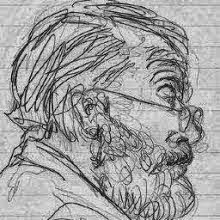
Matthew Jockers in introducing Willard’s Busa lecture memorably described him
as the ‘Obi-Wan Kenobi of digital humanities’, a denomination which Willard
relished.
Occasional lectures of this kind can often
be damp squibs, but Willard’s Busa lecture was truly memorable, because it
mapped out an intellectual manifesto for the future of the digital humanities
which is ambitious, exciting and inspiring. The title illustrates the ambition of the lecture: 'Getting There from Here: Remembering the Future of the Digital Humanities'. Willard’s lecture was
live-streamed, and I understand that the archive video will shortly be
available online. We are arranging for Willard to repeat his lecture at King’s
in the autumn, and it will be published.
Willard’s lecture was incredibly rich and
intellectually challenging, so it might be worth starting the process of
unpacking his message. Willard’s lecture will I am sure lead to as much
discussion and debate as his 2005 book on
Humanities Computing, and the lecture should be seen as the next move
forward from what Willard describes as the ‘intellectually claustrophobic
territory’ represented by his book. Among the key themes in Willard’s lecture
to which I would draw particular attention are:
- ‘Failure
is our most important product’. In describing his work to see how far
tagging could capture aspects of Ovid’s ‘Metamorphoses’, Willard urges us to
move away from our preoccupation with creating user-friendly online resources
which will enable humanities scholars with low levels of computer literacy more
easily to search and interrogate their primary materials. Willard urges a more
experimental digital humanities which explores the limits and inadequacies of
computing. I couldn’t agree more. For too long, we have seen ourselves as
evangelists of technology, trying to convince humanities scholars that machines
can be helpful. The risk now is that, as digital technologies become
commonplace in the academy, we will assume that there is only one way of doing
things, a series of methods and standards which have to be shared and
disseminated. The result will be an evisceration of the possibilities of the
digital humanities. The only way to avoid this is to embrace that sense of
computing as an ‘ongoing, never ending experimental process’ described by
Willard, but that means radically changing the type of things we assume that
digital humanities should do – death to projects; more experiments, more
tinkering, more just trying out.
- ‘Imaginative
exploration’. Willard picks up on
Busa’s 1976 question ‘Why can the computer do so little?’ to criticize our
assumption that computers simply enable us to reduce the drudgery of
scholarship by performing routine tasks more quickly. Thinking of the computer
as a ‘mere’ tool is a way of making it safe – it becomes from this perspective just
a humdrum piece of technology which gets rid of the tedious aspects of
research. Such thinking is a way of avoiding confronting the radical
epistemological and phenomenological implications of computing. If we think of
digital humanities as a series of ‘methods’ which can be ‘applied’, we are
complicit in such denial of the radical implications of the computer. Digital
humanities is not a series of methods which can be learnt or introduced but
rather a field of exploration. We need to focus on imaginatively exploring the
potential (and limitations) of computing rather than on creating ever more
efficient scholarly data crunching.
- Learning
from artists. Referring back to the 1968 Cybernetic Serendipity exhibition at the Institute of Contemporary
Arts, ‘at which artists and engineers experimented with ideas so far ahead of
their time they remain mostly ahead of ours’, Willard urges those engaged in
the digital humanities to create a stronger dialogue with technologically aware
artists. This is a theme I have found echoed in my own work on the AHRC’s
‘Digital Transformations’ theme where it has become evident that the time is
ripe for a stronger cross-over between the digital arts and the digital
humanities. The kind of work with arduinos, conductive inks or mBed
microcontrollers is precisely the field for that restless experimentation, the
constant tinkering, that Willard urges us to engage in.
- ‘We
need the techno‑sciences just as much, more than many of us realize, more than some
of us fear.’ Willard powerfully argues the need for the digital humanities to
connect more closely with the sciences. At one level, this is simply because
the discipline will wither and die if it loses its connection with its
epistemological roots. At another, shared issues and concerns mean that
scientists are people we can and should be talking to. One of the most
fascinating events I attended recently was a multi-disciplinary workshop on theproblems of Big Data organized by the Large Hadron Collider community. The
cross-connections and parallels across different disciplines were fascinating.
We need more of that sort of dialogue – we won’t learn much new from talking to
historians or classicists but talking to scientists will lead us into
completely fresh pastures.
- Where
is the criticism? Willard, taking up questions posed by Alan Liu and Fred
Gibbs, emphasizes the importance of retaining a critical stance in exploring
these areas. Indeed, one of the things which we as humanities scholars bring to
the table in discussions with scientists and technologists are the remarkable
theoretical tools which are among the great intellectual achievements of the
past fifty years (and in turn have their roots in the scientific discoveries of
men like Einstein, Heisenberg and Freud). The most fruitful areas of future
development for the digital humanities will be at these intersections of science,
art and criticism – as critical code studies are beginning to illustrate. A key
element for this in Willard’s discussion is the importance of historicizing our
understanding of an engagement with computing.
-
Resonate with the humanities! Just as digital humanities wilts if it
ignores its roots in computing science, likewise its roots in the humanities
cannot be forgotten. Willard expresses the aim perfectly when he says that the
results of our foraging across the sciences, technology, arts and culture should
‘resonate with the humanities’. The mix we produce from our hunter-gatherer
expeditions will not necessarily fall into such easily recognizable categories
as history, literature or archaeology, but what we find and express should have
resonances across all these disciplines. Here, I think we can draw inspiration
from disciplines such as bibliography or manuscript studies. To take an example
from my own work, my study of the restoration of the burnt manuscripts of Sir Robert Cotton has, I believe, implications across a range of historical,
literary and other studies, but I would find it difficult to categorise it as
history or literature – I hope it has wider resonances, as our DH experiments
should.
Willard described in his Busa lecture a new
type of digital humanities. This is a digital humanities which remembers its
roots and traditions – indeed to some extent Busa’s 1976 question ‘Why can a
computer do so little?’ provides the key epigram for the lecture. It is a
digital humanities which is intellectually restless and exists in marginal
lands: ‘I’ve imagined us as maritime explorers in an archipelago of
disciplines, peripatetic, prowling the margins; I’ve imagined us with the
novelist David Malouf, adventurous youth discovering life and death in a wild,
dangerous acre of bush’. This area is defined by a triangulation between
science, digital arts and making and cultural criticism. It is an area of
experiment – of tinkering and playing with cross-connections. It is a zone of
failure but also of restless intellectual energy.
At the end of his lecture, Willard
commented how the digital photograph albums we increasingly produce in the name
of improved access distort and oversimplify our understanding of the act of
remembering. It is a tragedy how so much of what we do in the digital
humanities denies the possibility of reinventing and changing the textual and
other forms we have inherited. Our ‘digital scholarly editions’ are so
conservatively conceived that they would be recognized and understood by the
Grimm Brothers; we continue to use the calendar form, deeply bound up with
print technology, to reproduce abridgements of historical documents; our
collections of images are little more than photograph albums. Is the computer
really no more than a digital photocopier? Does our digital humanities work explore
whether it has greater potentiality? If we are to embrace Willard’s vision of a
more intellectually restless and experimental digital humanities, we need to
abandon many of the assumptions we have made about what we do in the digital
humanities. Building endless numbers of unimaginative, repetitive, stereotyped and
hidebound projects is not enough. As digital humanities develops, it is
difficult to escape the suspicion that for many the routine creation of digital
projects or the cutting and slicing of data provides a quiet peaceful haven,
where we can code quietly without the risk of demanding intellectual challenges
or complex theoretical considerations. Data is too often at the moment seen as
a substitute for thought. Willard’s fundamental message is that digital
humanities should be intellectually demanding and challenging, posing fundamental
philosophical and theoretical questions at every turn. Willard describes here
the intellectual constituency of the digital humanities, and it is the
exploration and investigation of this constituency which should be our concern.
We can discuss pointlessly and forever how big and what shape the text of the
digital humanities should be (and what the labels on the door mean), but in the
end it is only the conversations that take place within it which count.

